
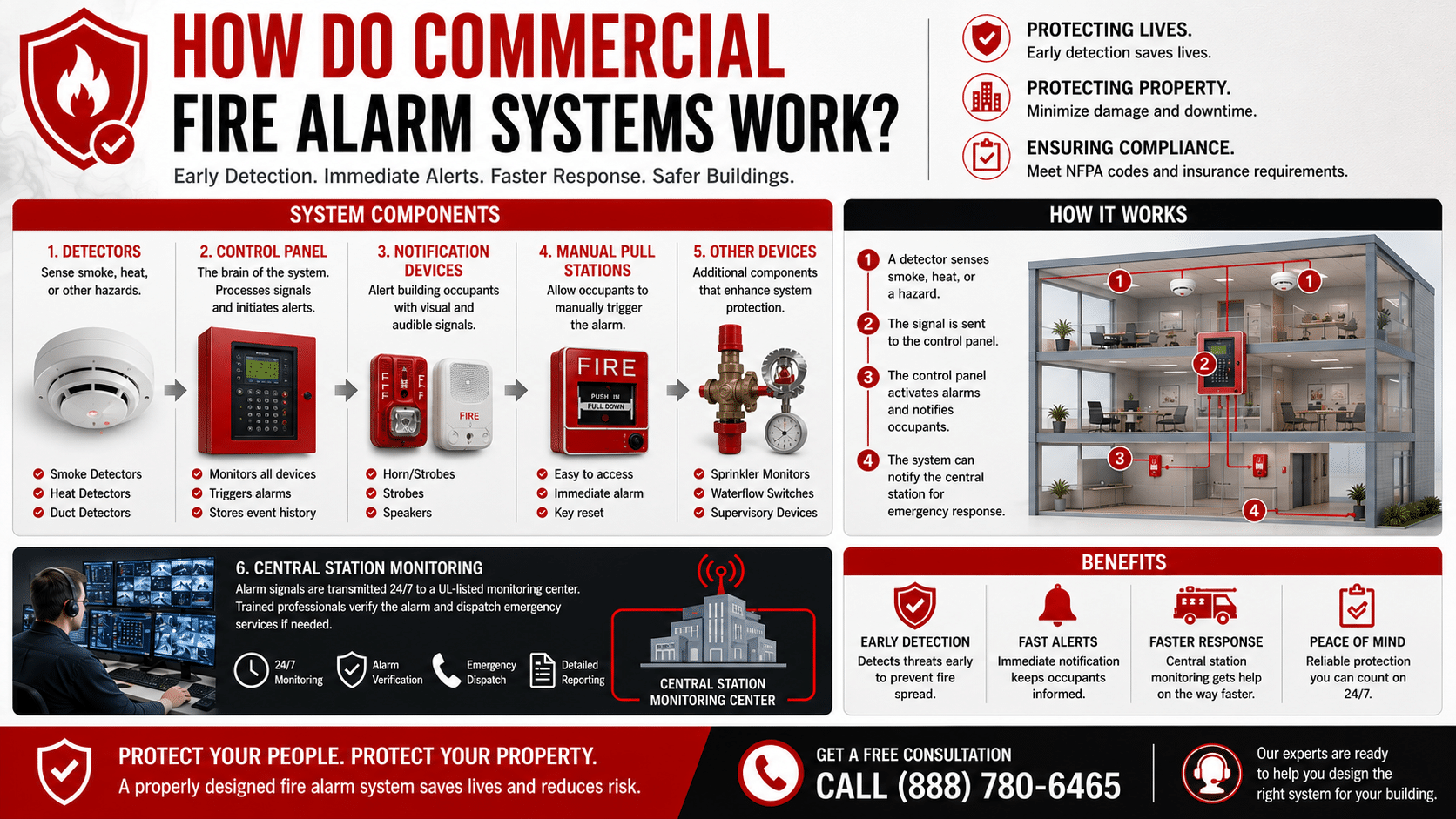
A commercial fire alarm system has to do two things without hesitation: detect a potential fire event and trigger the right response fast enough to protect people, property, and operations. When facility teams ask, how do commercial fire alarm systems work, the real answer is not just “they sound an alarm.” In a commercial setting, the system is a coordinated life safety network built to detect, communicate, control, and document events under strict code requirements.
That distinction matters. A small nuisance issue in a retail suite is different from a smoke condition in a hospital, high-rise, school, data center, or airport. Commercial systems are designed around occupancy type, hazard level, evacuation strategy, monitoring requirements, and integration with other building systems. The result is a system that does much more than activate horns and strobes.
How commercial fire alarm systems work in a building
At the center of the system is the fire alarm control panel, often called the FACP. Think of it as the decision-making hub. It supervises field devices, receives signals, evaluates programmed logic, displays system status, and initiates outputs when certain conditions are met.
Across the building, initiating devices act as the system’s eyes and hands. Smoke detectors, heat detectors, duct detectors, beam detectors, pull stations, waterflow switches, and tamper switches each send a specific signal back to the panel. Some signals indicate a likely fire event. Others indicate supervisory or trouble conditions, such as a closed sprinkler valve being opened or a circuit problem that needs service.
Once the panel receives an alarm signal, it follows its programmed sequence. That may mean activating notification appliances throughout the building, releasing doors, recalling elevators, shutting down air handling units, signaling a supervising station, or initiating suppression-related functions. In many commercial properties, these actions happen in a defined order based on code, engineering design, and the building’s operational needs.
The main components and what each one does
A commercial fire alarm system works because several layers are doing different jobs at the same time.
The control panel supervises the entire system. It constantly checks whether devices are online, circuits are intact, batteries are healthy, and communication paths are functioning. If something is wrong, the panel generates a trouble signal even when there is no fire.
Initiating devices detect conditions or allow occupants to report them manually. Smoke detectors sense combustion particles. Heat detectors respond to fixed temperature or rate-of-rise changes. Pull stations let a person trigger an alarm if they see danger before automatic detection occurs. Waterflow switches indicate sprinkler activation, while tamper switches supervise sprinkler control valves.
Notification appliances are what occupants typically notice first. Horns, strobes, speakers, and speaker-strobes alert people to take action. In some buildings, that means full evacuation. In others, especially larger or more complex occupancies, the system may support phased evacuation or voice instructions.
Power supplies and backup batteries keep the system operational when normal power is lost. That is a core life safety requirement, not an optional feature. If utility power fails during an emergency, the alarm system still has to perform.
Communication paths connect the building to a supervising or central monitoring station when required. If the system goes into alarm, that signal can be transmitted off-site so emergency response can be dispatched according to the monitoring protocol.
Detection is only the first step
One of the biggest misunderstandings in commercial fire protection is assuming detection equals response. Detection starts the process, but system programming determines what happens next.
For example, smoke in an air duct may trigger HVAC shutdown to help prevent smoke migration. A sprinkler waterflow signal may activate evacuation notification, transmit to monitoring, and trigger smoke control sequences. In a high-rise, the panel may unlock stairwell doors, recall elevators, and activate voice communication only on certain floors first.
This is why design quality matters so much. Two buildings of similar size may need very different fire alarm strategies. Occupancy classification, local code amendments, authority having jurisdiction requirements, and the presence of sprinkler, suppression, access control, smoke control, or mass notification systems all affect how the alarm system should be configured.
Conventional vs. Addressable systems
If you manage an older property, you may have a conventional fire alarm system. In this setup, devices are grouped into zones. When an alarm occurs, the panel identifies the zone, but not always the exact device. That can slow investigation in larger buildings.
Most modern commercial installations use addressable systems. Each device has its own digital identity, so the panel can report the exact detector, module, or pull station in alarm or trouble. That improves speed, service efficiency, and event clarity. For larger campuses, healthcare environments, multifamily properties, schools, and complex commercial facilities, addressable systems are usually the better long-term fit.
The trade-off is cost and complexity. Addressable systems typically require more specialized programming and commissioning, but they offer stronger diagnostics, more precise information, and better scalability when the building changes.
How monitoring and emergency response fit in
Commercial fire alarm systems often connect to a supervising station that receives alarm, supervisory, and trouble signals. That monitoring layer adds accountability when a building is unoccupied, after hours, or spread across multiple tenants.
An alarm signal generally prompts notification to emergency responders based on the site’s instructions and applicable requirements. Supervisory signals indicate conditions that could impair fire protection, such as a valve change. Trouble signals point to system faults like ground faults, low batteries, communication failures, or device issues.
For property managers and operations leaders, this distinction matters. Not every signal means there is an active fire, but every signal needs the right response. Confusing alarm, supervisory, and trouble conditions can lead to delays, unnecessary dispatches, or missed compliance issues.
Why false alarms happen
False alarms are not just frustrating. They disrupt operations, create tenant complaints, strain fire department relationships, and can lead to fines in some jurisdictions.
Common causes include poor detector placement, dust during construction, lack of maintenance, aging devices, environmental conditions, and programming problems. In mixed-use or tenant improvement environments, changes to airflow, ceiling layout, room use, or access control often affect system performance more than building teams expect.
This is where experienced engineering, installation, and service support make a measurable difference. A commercial fire alarm system should be designed to reduce nuisance activity without weakening life safety performance. That balance is not automatic. It takes code knowledge, device selection discipline, and proper testing.
Testing, inspection, and maintenance are part of how the system works
A fire alarm system is not truly working just because it is installed and powered on. In commercial environments, inspection, testing, and maintenance are part of the system’s function over time.
Devices drift. Batteries age. Tenant spaces get renovated. HVAC settings change. Notification appliances get damaged. Monitoring paths fail. Any of those issues can turn a compliant system into a liability if they are not identified quickly.
Routine inspections and testing help confirm the system still performs as designed and still meets applicable standards. They also create the documentation owners and facility teams need for compliance, insurance, audits, and authority review. If your site has recurring trouble conditions or repeated false alarms, that is usually a sign the system needs more than a reset. It needs diagnosis.
For organizations managing multiple facilities, a single provider that can handle fire alarm service, sprinkler interface, monitoring coordination, and related low-voltage integration often reduces delays and finger-pointing. That is one reason many commercial clients prefer an integrated life safety partner rather than several disconnected vendors.
What building owners should really ask
Instead of only asking how do commercial fire alarm systems work, a better operational question is whether the system in your building is working the way your occupancy, risk profile, and code obligations require.
A compliant system on paper can still create practical problems if it is difficult to service, poorly documented, improperly programmed, or out of step with current building use. A hospital expansion, hotel renovation, warehouse reconfiguration, school addition, or multifamily upgrade can all change what the system needs to do.
That is why commercial fire alarm performance should be evaluated in context. The right approach includes design intent, current code requirements, integration with other life safety systems, inspection history, monitoring reliability, and how quickly qualified technicians can respond when something goes wrong. Companies such as Control Systems Inc. are built around that full-cycle model because life safety systems rarely perform well when responsibility is fragmented.
A commercial fire alarm system works best when it is treated as active infrastructure, not a background utility. If your system gives clear information, activates the right building responses, passes inspection, and gets expert support when needed, it is doing its job long before an emergency puts it to the test. Call Control Systems, Inc to learn more about your system.