
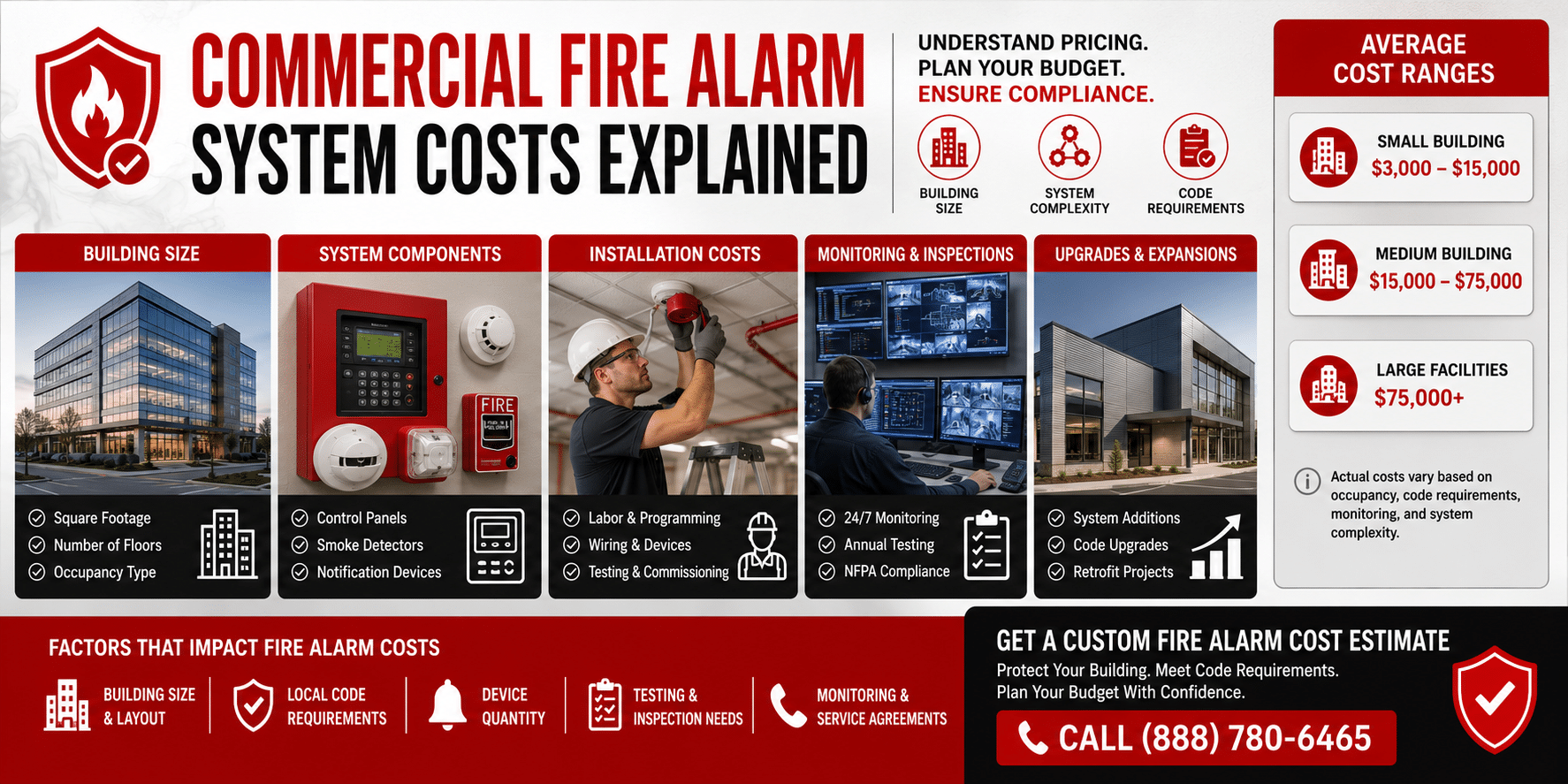
If you are budgeting a tenant improvement, a ground-up build, or a system replacement, commercial fire alarm system cost is one of the first numbers stakeholders want and one of the easiest to underestimate. A basic price per device or per square foot rarely tells the full story. In commercial environments, cost is tied to code requirements, building use, integration needs, permitting, and the quality of the design and installation team.
That matters because the cheapest number on paper can become the most expensive path in the field. Change orders, failed inspections, programming issues, false alarms, and rework all drive up total project cost. For owners, developers, general contractors, and facility leaders, the right question is not just what a system costs to buy. It is what it takes to get a compliant, reliable system installed, accepted, and supported over time.
What drives commercial fire alarm system cost
The biggest factor is building scope. A small single-tenant commercial space with limited devices will cost far less than a high-rise, healthcare facility, hotel, school, or mixed-use property with extensive notification, smoke control interfaces, elevator recall, sprinkler monitoring, and emergency communication requirements. Occupancy type changes everything because code and life safety expectations change with it.
Device count is another major cost driver, but not in isolation. Pull stations, horn strobes, smoke detectors, duct detectors, monitor modules, control modules, annunciators, power supplies, and communication equipment all add hardware cost. Labor often rises just as fast because every device must be located correctly, wired, addressed, tested, and documented.
Panel selection also affects pricing. Some buildings need a straightforward addressable control panel with limited capacity. Others need a networked platform that can support expansion, multiple buildings, graphics, mass notification, smoke control logic, or integration with access control and suppression systems. More capability typically means higher equipment and programming costs, but it may reduce future upgrade costs if the facility is expected to grow.
Commercial fire alarm system cost by project type
For a retrofit, pricing is often less predictable than owners expect. Existing conditions create unknowns. Concealed spaces, outdated wiring, asbestos concerns, inaccessible ceilings, occupied work areas, and phased installation requirements can all increase labor. If the existing system is obsolete or parts are unavailable, replacement decisions may be driven by serviceability as much as by code.
In new construction, costs are usually easier to control when fire alarm design is coordinated early with electrical, mechanical, sprinkler, elevator, and security scopes. Delays happen when the fire alarm contractor is brought in after architectural and MEP decisions are already locked in. That is when device locations conflict with ceiling layouts, duct detectors are missed, riser pathways are not planned, or required interfaces are left out of the budget.
Tenant improvements sit somewhere in the middle. A small office remodel may only need minor device relocation and programming changes. A restaurant, medical suite, school expansion, or industrial tenant fit-out may trigger much more substantial modifications, especially if occupancy classification, egress, or sprinkler monitoring requirements change.
Typical price ranges and why they vary
There is no single national number that fits every commercial property, but broad budgeting ranges can still be useful. Smaller commercial projects may land in the low five figures, while larger or more complex systems can move quickly into six figures. Enterprise campuses, hospitals, airports, high-rise buildings, and large mixed-use developments can exceed that by a wide margin.
Square-foot pricing is often used for early budgeting, but it should be treated carefully. A warehouse with limited notification and detection needs may have a much lower cost per square foot than a healthcare facility of the same size. A hotel, multifamily property, school, or detention facility may require significantly more devices, interfaces, and survivability features. The square footage alone does not capture that complexity.
The more reliable way to think about pricing is in layers: base panel and communication equipment, field devices, wiring infrastructure, programming, integration, permit and plan review fees, testing and acceptance, and long-term monitoring and service. A low number in one layer may simply mean costs are being deferred or omitted.
Design, engineering, and code compliance are part of the cost
One of the most common budgeting mistakes is treating design as optional. In commercial fire alarm work, engineering and code-driven layout are central to the final cost and to the success of the project. Jurisdictional requirements, adopted editions of NFPA codes, local amendments, and owner standards all influence system scope.
A well-designed system helps prevent expensive field corrections. It also improves submittal approval timelines, coordination with other trades, and final acceptance testing. When design is rushed or incomplete, installers and project managers end up solving code and coordination issues in the field, where every correction costs more.
This is especially true in facilities with layered life safety requirements. Healthcare, education, hospitality, high-rise, industrial, and government environments often require detailed sequence of operations, emergency control interfaces, and precise documentation. Those requirements are not line-item extras. They are part of delivering a compliant system.
Labor and installation conditions can change the budget fast
Hardware gets attention because it is easy to count. Labor is where many budgets move. Working in an occupied hospital, active hotel, airport, correctional facility, or data center is not priced the same as working in an empty shell building. Night work, infection control protocols, security clearances, lift access, patching, and phased turnover all affect installation cost.
Geography matters too. Labor rates, permit costs, inspection practices, and local code expectations vary across markets. A project in Phoenix, Denver, Dallas, Orlando, or Birmingham may have different cost pressures even when system scope looks similar on paper.
Schedule compression also raises cost. If the project team waits too long to finalize drawings, approve submittals, or coordinate other trades, the fire alarm contractor may need to add manpower, overtime, or rework to hit the turnover date. Owners and GCs usually feel those costs one way or another.
Monitoring, inspections, and service affect total ownership cost
Initial installation is only part of the financial picture. Commercial fire alarm systems require ongoing inspection, testing, maintenance, and in many cases central station monitoring. Those recurring costs should be planned from the start, not treated as an afterthought.
A lower installation number can be misleading if the system is difficult to service, built with aging components, or installed without clear documentation. Service calls, nuisance alarms, replacement parts, and tenant disruption can make an inexpensive system costly over its life cycle.
This is where provider capability matters. A commercial facility benefits from a contractor that can handle design, installation, testing, inspection, monitoring, and emergency service under one roof. That approach reduces handoff issues and gives owners better accountability when something needs attention. For many organizations, that operational reliability is worth more than shaving a small percentage off the front-end number.
How to budget commercial fire alarm system cost more accurately
Start with the occupancy type and the actual use of the space, not just the floor area. Then confirm what the authority having jurisdiction requires, what the insurance carrier may expect, and whether the building has related systems that need to be monitored or controlled. Sprinkler risers, fire pumps, clean agent systems, elevator controls, smoke dampers, access control release, and emergency communication features can all affect scope.
It also helps to define whether you need a simple code-minimum system or a platform that supports future growth, integration, and easier serviceability. Going too small may create upgrade costs later. Going too large can waste capital if the building has no realistic expansion path. The right answer depends on the asset, the risk profile, and how long you plan to hold or operate the property.
Most important, get pricing from firms that understand commercial life safety work, not just basic device installation. A qualified integrator should be able to explain scope assumptions, exclusions, code basis, testing requirements, and service expectations in plain language. That clarity is what keeps the budget grounded in reality.
At Control Systems Inc., that is the standard commercial clients expect: accurate scoping, code-compliant execution, and dependable support after turnover. In a life safety system, cost matters, but confidence in performance matters more.
When you evaluate a fire alarm budget, look past the headline number and focus on what is actually being delivered. The best investment is the one that protects people, keeps the project moving, and holds up when the inspection happens and long after it passes.