
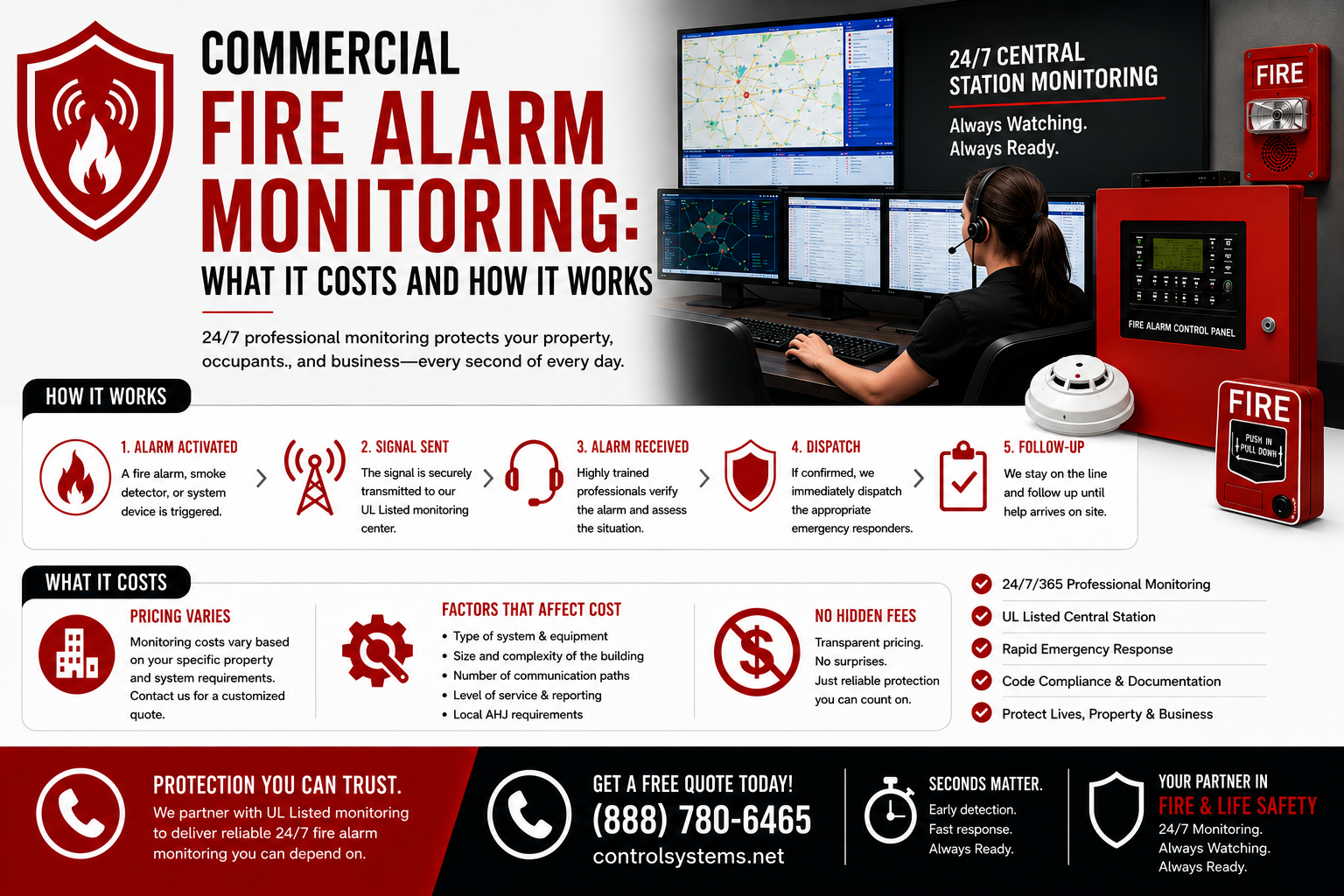
A fire alarm system that isn’t monitored is only doing half its job. Detection without notification means a fire can trigger every horn and strobe in your building — but if no one calls the fire department, the response depends entirely on someone inside noticing and reacting fast enough. Here’s how commercial fire alarm monitoring actually works, and what affects the cost.
How Fire Alarm Monitoring Works
When a fire alarm system detects smoke, heat, or activates a pull station, a signal is sent to a UL-listed central monitoring station — staffed 24 hours a day, 365 days a year. Monitoring personnel verify the signal and immediately dispatch the fire department, whether or not anyone in the building calls 911 themselves.
Signals can be transmitted several ways:
- Traditional phone line (POTS): The oldest method, increasingly being phased out as carriers retire copper lines
- Cellular monitoring: Uses a dedicated cellular radio, independent of the building’s phone or internet service
- Network/IP monitoring: Transmits over the building’s internet connection, often paired with cellular as a backup
Most modern commercial installations use cellular or dual-path (cellular + network) monitoring, since it doesn’t depend on a phone line that could be damaged in a fire.
What Affects the Cost
Monitoring costs vary based on:
- Building size and system complexity — more devices and zones generally mean more to monitor
- Transmission method — cellular and dual-path monitoring typically cost more than a basic phone line, but offer far better reliability
- Additional services — mass notification, voice evacuation, and elevator recall integration add to system complexity and monitoring requirements
- Contract term and provider — monitoring is usually billed monthly or annually as part of an ongoing service agreement
Why UL-Listed Monitoring Matters
Not all monitoring services meet the same standard. A UL-listed central station is held to strict requirements for staffing, redundancy, and response time — which matters both for genuine life-safety reliability and because many insurance carriers and local codes require UL-listed monitoring specifically.
How Control Systems Inc. Helps
Our monitoring partner, Advanced Monitoring Inc., operates a UL-listed central station providing 24/7/365 monitoring across all of our service markets, with network, cellular, and traditional phone line options available depending on your building’s needs. If you’re not sure whether your current system is being monitored the right way, we’re happy to take a look.